Why Patients Travel From Around the World for Dr. Keojampa
Most facial plastic surgeons build a practice around a handful of signature procedures. Dr. Kyle Keojampa has built his around something far rarer: the ability to move fluidly between the skull, the jaw, the airway, and the soft tissue of the face in a single, cohesive surgical plan. It’s this breadth, paired with a depth of experience in each individual procedure, that has made Keojampa MD Facial Plastic Surgery a destination practice. Patients don’t just come from across California or the United States. They fly in from Europe, Asia, the Middle East, and beyond, often booking 12 to 18 months in advance, because the combination of skills they need simply doesn’t exist together anywhere else.
A Surgeon Who Operates Above the Neck Only
Dr. Keojampa completed his training in Otolaryngology, Head and Neck Surgery, Facial Plastic Surgery, and Facial Feminization Surgery at Boston University Medical Center, later serving as a Clinical Assistant Professor at both Boston University and Harvard Medical School. He is board certified in Facial Plastic Surgery and a Fellow of the American College of Surgeons. His practice is intentionally narrow in scope and limited entirely to the face, head, and neck, which allows him to operate at a level of precision and bone-level mastery that few general plastic surgeons ever develop. He performs hundreds of major craniofacial cases each year, supported by AAAASF-accredited surgical facilities with Medicare-deemed status.
What sets the practice apart isn’t any single procedure. It’s that the same surgeon who can reshape the skull can also lift the deep structures of an aging face, restructure a jaw for both function and aesthetics, and refine the airway, all with an understanding of how each of these systems affects the others. That kind of cross-disciplinary command is what patients are really traveling for.
Aesthetic Craniofacial Surgery
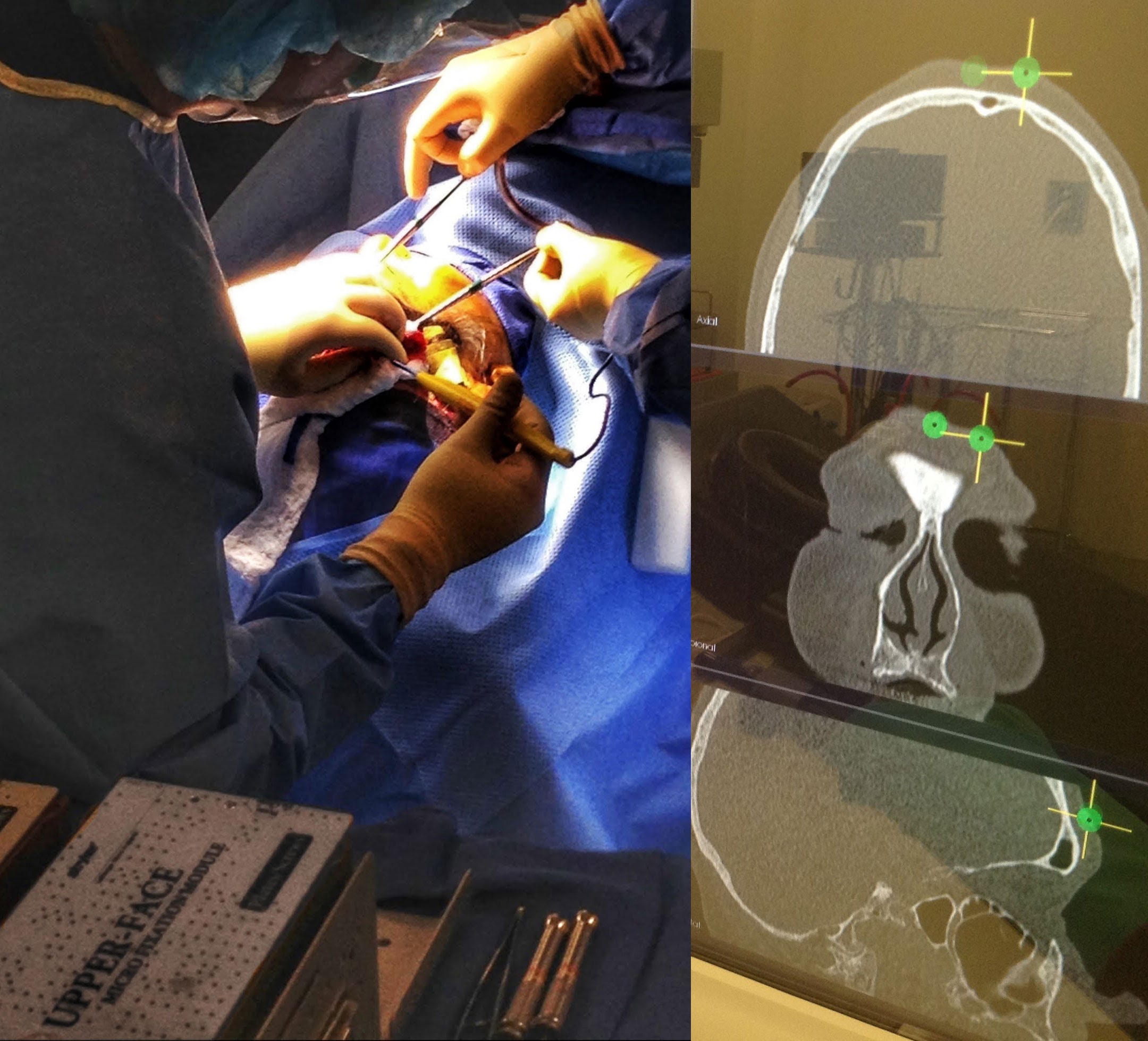
Craniofacial surgery, reshaping the actual bone structure of the skull, brow, and jaw, has traditionally lived in the world of reconstructive medicine for trauma and congenital conditions. Dr. Keojampa applies that same surgical foundation to aesthetic goals: softening or strengthening a brow, refining the contour of the skull, and balancing the proportions of the upper face. He uses real-time stereotactic CT image guidance during these procedures, the same navigation technology neurosurgeons rely on to work within a fraction of a millimeter of critical structures. Combined with a Sonopet ultrasonic bone scalpel, which contours bone without engaging or injuring surrounding nerves and soft tissue, this gives patients a level of precision and safety rarely available outside of major academic medical centers.
Forehead Cranioplasty
Few procedures demonstrate Dr. Keojampa’s specialization as clearly as forehead reduction cranioplasty. This involves surgically reducing the bony prominence of the brow and reshaping the frontal bone itself, not simply adjusting soft tissue or adding filler. It is technically demanding, requires an intimate understanding of the frontal sinus, and carries real risk in inexperienced hands. Dr. Keojampa is recognized as one of a very small number of surgeons worldwide with deep, high-volume experience in this specific operation, which is why patients seeking true structural forehead reshaping consistently find their way to his practice rather than a local cosmetic surgeon.
Lip Lifts
The lip lift has become one of the most requested procedures in facial rejuvenation, but it is also one of the most easily mishandled. A poorly executed lip lift can leave a visible scar, an unnatural smile, or asymmetry that’s difficult to correct. Dr. Keojampa’s approach is built on the same precision and attention to facial proportion that defines his craniofacial work, shortening the distance between the nose and the upper lip while preserving natural movement and expression, with incisions designed to heal discreetly.
Deep Plane Face Lifts
A deep plane face lift is widely considered the gold standard in facial rejuvenation, and also one of the most difficult techniques to perform well. Rather than simply tightening skin, it releases the facial retaining ligaments and repositions the deeper structural layers of the face so that the muscle, not the skin, bears the tension of the lift. Done correctly, the result is closure without strain on the skin itself, producing a natural, unoperated appearance rather than the pulled or wind-tunnel look associated with older techniques. Achieving a tension-free lift at this depth requires complete release of those retaining ligaments, something only a small number of surgeons worldwide can perform safely and consistently. It’s a procedure built on the same anatomical command Dr. Keojampa applies to bone work, simply expressed in soft tissue instead.
Aesthetic Orthognathic Surgery
Orthognathic, or jaw, surgery is traditionally performed to correct bite problems and is typically planned around occlusion first and appearance second. Dr. Keojampa approaches it differently, prioritizing facial aesthetics and airway function alongside bite correction, using procedures such as LeFort 1 osteotomy and bilateral sagittal split osteotomy (BSSO) to reposition the upper and lower jaw together. This is especially significant for patients with facial asymmetry, midface hypoplasia, or vertical maxillary excess, where the difference between a surgeon focused purely on occlusion and one trained to also see the whole face can be the difference between a corrected bite and a transformed, balanced face. He is one of a limited number of surgeons internationally who routinely Facial feminization surgery combined with double jaw surgery.
Scarless Tracheal Shave
Reducing the prominence of the thyroid cartilage, commonly called a tracheal shave, sits directly beside the airway and vocal cords, leaving very little room for error. Dr. Keojampa performs this procedure through a scarless approach, addressing the cartilage prominence while minimizing visible incision, a refinement that requires both surgical confidence and an intimate familiarity with neck anatomy built over hundreds of procedures.
The Common Thread
Individually, each of these procedures already narrows the field of qualified surgeons considerably. Together, performed by one surgeon who treats the skull, jaw, airway, and face as a single interconnected system, they narrow it to almost no one. That is the real reason patients board planes from other continents to sit in a San Francisco consultation room: not for one exceptional procedure, but for a surgeon capable of planning and executing all of them in concert, with the judgment to know exactly how a change to the jaw will read in the brow, or how a forehead cranioplasty will balance against the rest of the face.
For patients who have spent years researching a specific, complex change they want made and have struggled to find a surgeon who can speak fluently to all of it, that combination of breadth and depth is, quite simply, hard to find anywhere else in the world.